

3 Buckets for Bad Shots
If you are a high to mid-handicap golfer trying to lower your scores, when reviewing your round, start placing your bad shots mentally into the following three buckets. By doing so, you’ll know what parts of your game you need to practice and focus on, and where the strokes are piling up. Is it all three buckets or just one? It’s a simple way to break down the harm to your scorecard and help you prioritize next steps.
Lost Balls
The first bucket is obvious. Losing the ball is a severe penalty. If you are losing a lot of balls, you can forget lower scores. If this bucket is full for you, start to think about WHY you lost each ball, and it can shed light on your game and mental approach. We all know friends who swing the driver hard with no control. 250+ yard drives in who knows what direction. These players might shift to working at the range on a stock cruising speed driver swing that is only 230 yards total with reliable dispersion. Some players lose balls because they don’t know their yardages per club, or they make course management errors. Examples might be hitting too much or too little club on an approach shot, resulting in a lost ball, or trying to drive the green on a short par 4 and plunking it into the pond. These are balls lost to mental mistakes and discipline. Some players lose balls because they can’t get the ball airborne consistently enough when they must carry it over hazards. These are balls lost due to a lack of ball strike consistency. Player X and Y can each lose 3 balls in the round, but for different reasons.
Severe Mishits
The second bucket is a catch-all for bad shots that are not lost balls or greenside short-game shots. I call these Severe mishits. This is by far the biggest bucket of bad shots for beginners and high handicappers. Severe mishits include all tops, shanks, fat shots, duffs, and skulls. A topped driver is a severe mishit. So is a duffed 45-yard pitch. If you hit an 8-iron 130 yards, and you catch your approach shot a little fat, and it’s 119 yards and a little right, that is NOT a severe mishit. You get the idea. Players with a lot of strokes in this bucket need to work on the fundamentals and shift their practice and goals to minimize severe mishits with balls on the ground.
Decent Short Game
This bucket includes your bad greenside chips and pitches, and your bad putts. Does it take you one or two chips to get onto the green? Does it take you 2 or 3 putts to get in the hole? I played nine holes last month with a student who started playing golf last season. After the round, we realized almost all his bad shots were from this short game bucket. For 8 of the 9 holes played, he was greenside in regulation. Meaning that for 8 of the 9 holes, he was either on the green in regulation or less than 10 yards from the green with a chance for an up and down. The scorecard did not reflect being that close to the hole in regulation for 8 of the 9 holes. As a takeaway, he knew his long game was in a good spot, and the next chunk of strokes to drop will be from the short game bucket. A good place to be!
If you start thinking about your game and your bad shots in terms of these 3 buckets, it can help you lay out a path and plan for what to work on to drop more strokes and lower your handicap.

Reflections on 1,600 Golf Lessons
I recently passed a milestone. 1600 golf lessons have been given since May 1, 2024! While every golf swing is different, many golfers have the same issues holding them back. This post details some of those common swing issues that affect a high proportion of the players I work with. Stay tuned for more posts that go in depth on these topics, and much more.
Reverse Pivot
There is a lot of reverse pivoting going on out there… But what is a “reverse pivot”, and how is it detrimental to your swing? What I call a reverse pivot is when a player, at the start of their backswing, has their lead knee move straight out away from their body, and the lead shoulder dives down towards the ball. At this point, the player's upper body and head are much lower than at address, and the bend from their lead foot to the lead shoulder looks like the letter C. Then, on the downswing and follow-through, the player lunges and straightens up their legs and upper body to counter the reverse pivot. Instead of 80% of their pressure on their lead side at impact, they end up 50-50 or even worse, hitting the ball off their trail foot, pulling back and away from the ball. This leads to problems with irons and hitting balls off the ground in general. Because the low point of the swing can be before the ball.
What the lead knee should do in the backswing is drift towards your trail knee instead of straight out and away from your body. This gets 80% of the pressure on your trail side early, so you can shift it to 80% on your lead side early in the downswing. An extreme reverse pivot bungles this timing because a big portion of the pressure is on your lead side for too long early in the backswing. If your lead knee drifts towards your trail knee on the backswing, it will also discourage your lead shoulder from diving down towards the ground too much. Cleaning up a reverse pivot will get you back to those crisp ball-first strikes off the turf.
Over the Top and Extreme Out-to-In Club Path
This issue is common, and anyone who has spent time learning the golf swing knows a lot about this. At the end of the backswing, the players’ hands move out and away from their body, as opposed to dropping back down on the same plane or underneath it. Now the player is forced into a steep out-to-in swing. Casting and early release of the clubhead can also be common as part of “making it work” with this move. During the downswing, we want to see sufficient shallowing of the club where the club is leaning somewhere between your trail shoulder and your trail forearm (down the line view). This is actually a wide range in that you can have a steeper swing and still shallow it sufficiently by impact. This is good news! Also, the phrase over-the-top is viewed as 100% bad, but it’s not. A lot of the best players who ever lived had a slight over-the-top move to begin the downswing. It’s just to the point where it’s not really visible to the naked eye. The extreme over-the-top swing has the hands going so far out in front of them that the only way for the club to get back to the ball is with an extreme out-to-in club path. This is common, and I consider myself to have a very high batting average working with students on this. I’ll get you to what I call “living under 6” meaning we’ll “quiet” your club path so it’s consistently from 0 to -6 degrees out-to-in on Trackman.
Pressure Shift to the Lead Side Happens Too Late
The weight and pressure transfer to the lead side for impact is probably the most important move in the golf swing. If you do this well, you will be a good ball striker who hits the ball first with a negative attack angle, and then your club enters the turf, making a divot after the ball. Good players do this like breathing, and it’s an afterthought for them. But a large portion of players struggle with this. The result is you have a lot of fat, topped, thin, and other what I call “severe mishits” that ruin the fun of playing golf. This is why I believe it’s so important. Hitting the ball first is a crucial first step to having fun on the golf course for a lifetime. When you watch the pros on TV and their swings in super slow motion, you will notice their pressure shift to the lead side actually starts during the end of the backswing. Watch from the hips down. There are many reasons why a player’s pressure shift can be off. Too many to list in this post. But I can say that when a new player comes in with the desire to be more “consistent”, the first thing I want to know when I hear that word is what does that player’s pressure shift look like, and how is it affecting their swing’s low point.
Setup Clean-Up
Some of the best lessons I’ve had where students are most happy at the end, because of the improvements made in just 1 hour, occurred by just doing what I call Setup Clean Up. This can be a wide range of things, but at the core, they have habits at address (before the swing) contributing to subpar shots. This can include poor ball position per club, hands too far forward or back compared to clubface, stance too wide, standing too close to the ball with driver and too far from irons, no lead-foot flare, grip too much in palms rather than fingers, arms bent at address, poor stance posture, and the list goes on. I haven’t even mentioned some of the grips I have seen (Yikes!), Setup clean-up is about identifying the habits that are 100% hurting your shots and changing them immediately.
Trail Side Sway and Trail Foot Tip-Over on Backswing
This one could be filed under the late pressure shift to the lead side because that is the result. But it is so common, and it happens so early in the swing, I thought it deserved its own mention. In this scenario, the players start their backswing and their hips sway away from the target as they should, but instead of stopping what should be a slight initial sway and starting their hip and shoulder turn, they keep swaying away from the target with very little turn. This forces all their pressure onto the outside of their trail foot, and their trail foot shoe literally tips over on its side. This destroys the rest of the swing, and the result is fat and topped shots. This is something that must change immediately. This too, is something that is very fixable once we slow down and discuss it and do the appropriate drills. I’ll get you loading on the inside of your trail foot for the start of the downswing so your shoe stays connected to the ground and you can then properly use and generate ground force. If your trail foot is tipping over during the backswing… look out!
Constant Open Club Face
This issue comes up frequently with experienced players, and it surprises me. In terms of how prevalent it is. Experienced players who leave the clubface open at impact on most shots. Frequently, these players describe before a lesson a slice they want to address. But after a bunch of swings, Trackman tells us the player’s club path is fine in that it’s consistently a low number on either side of zero. Swings that, if the face angle were zero, would be a slight fade or draw. But the face angle is open 5 to 10 degrees more often than not. More good news here! This is also an easy fix. In fact, I would go as far as saying that by just making an experienced player aware of this, the fact that they are leaving the face way open or closed is enough for them to clean it up during the session largely on their own. Small tweaks to the grip on each hand, stopping the twist of the hands during take-away, or a better release of the hands and clubhead for impact, are all part of the drills and fixes I have for this. In fact, I love taking 10 minutes during a lesson to play what I call “the club face game” with students. You’ll have to take a lesson and find out. Clubface control is arguably the most important skill in golf.
swing Too Shallow
Is it possible to have a swing that is too shallow? Yes, it can be too much of a good thing. I will write a longer post dedicated to this interesting issue that has brought good players to me. To boil it down simply, having a swing too in-to-out can mean low point problems, hands and arms stuck problems, hand and clubhead release problems, low and wild duck hooks, and other not-so-good stuff to make you just want to go home.
Swing Ending at the Ball
This common problem is several issues rolled into one catch-all category. Approaching the golf swing as if it ends at the ball, as opposed to keeping the club going fast past the ball with a powerful finish and follow-through post-impact. Players swing like they are smacking a mosquito on the wall, where nothing matters but the initial impact. I want to be clear, this is a concept and more of a mental item rather than something technical in the swing. These players aren’t trying to, but subconsciously, they are playing a “hit the ball” game instead of an “advance the ball game”. I would even say club speed might be slowing down by impact. This can show up in your swing as chicken-wing arms post -impact, very rushed swing tempo, casting or early release of the clubhead before impact, open club face, and low-point consistently before the ball. I have several drills for this that emphasize the swing after impact and will get you moving towards someone who “swings the club” rather than someone who “hits the ball”.
Loss of Lead-Arm Extension
We’ve all been told to keep our lead arm extended during the backswing. But so many lose that extension during the second half of their backswing. It’s easy to keep it extended early, but then when the hands get to your ribs and above, players lose the extension and their hand unit moves close to their head. While you can hit OK shots like this, you will be forced to be very handsy in the impact zone. Whereas with an extended lead arm, the path to impact is more reliable, with more power, and a much simpler club head release is possible with less flipping of the hands. Again, like the other issue, there are several causes for this. One is a total lack of hip and shoulder turn. Another is an inside take-away where the lead arm goes flat across your body during the backswing. Another is some hip turn, but very little accompanying chest and shoulder turn.
These are but a drop in the bucket in terms of the possible swing issues and opportunities we may address during a golf lesson. I would like to thank all my students and players who made it possible for me to reach 1,600 lessons in the past 18 months. I’ve enjoyed every second!

Beginner Golf Lessons in Southborough, MA: What to Expect in Your First Session
Starting your golf journey can feel overwhelming — from learning the rules and etiquette to figuring out equipment and swing mechanics. At 495 Golf in Southborough, MA, I specialize in making those first steps simple, fun, and confidence-building. If you’ve been to the driving range or TopGolf a few times but have little or no on-course experience, here’s exactly what to expect in your first beginner golf lesson near you.
Grip, Stance, and Posture Fundamentals
In the first 10 minutes, you’ll get comfortable with the core fundamentals every golfer needs:
Grip: Learn the three main types using grip trainers — 10-finger, interlock, and overlap — and how to choose one that fits you.
Stance & posture: I’ll show you how to balance properly with weight over the balls of your feet (not your heels or toes).
Ball & club position: You’ll discover how ball placement changes with each club and how to set your clubface correctly at address.
These fundamentals lay the foundation for a consistent, repeatable swing.
Weight Transfer and Swing Basics
Before hitting balls, I introduce some swing essentials that every beginner should know:
Weight transition: Using a pressure plate, you’ll see how 80% of your weight shifts to your trail side during the backswing, then 80% to your lead side early in the downswing.
Impact position: We’ll break down what all great players share at impact — hands ahead of the ball, lead side engaged, and proper pressure shift.
Attack angle: Using the TrackMan 4 launch monitor, you’ll understand why good wedge and iron shots require a slightly downward strike.
This helps you abandon the common beginner myth that you need to “scoop” the ball to get it airborne.
Simple, Confidence-Building Drills
Rather than overwhelming you with swing theory, we’ll start with easy drills designed to build confidence:
Pinch drill: Using an 8- or 9-iron, you’ll focus on a short, simple swing that produces crisp, ball-first contact.
Feedback with technology: Launch monitor metrics (attack angle and swing low point) help you “see” good contact.
Sound & feel awareness: You’ll learn the difference between solid shots and mis-hits (fat, thin, shank, top) and how to correct them.
If time allows, we’ll finish with driver basics, where I explain why it’s the only club where an upward attack angle is beneficial.
Building Confidence and Next Steps
By the end of your first beginner golf lesson at 495 Golf, most students:
Hit multiple solid, satisfying shots.
Gain confidence that golf isn’t a mystery or “magic trick.”
Leave excited to return and continue improving.
Future beginner lessons will reinforce these fundamentals while introducing concepts like club path, clubface control, pitching, chipping, and putting. Each session is tailored to your unique swing and goals.
Ready to Book Your First Lesson?
If you’re searching for beginner golf lessons in Southborough, MA or a golf instructor near you, 495 Golf is here to make your first golf experience positive and rewarding.
👉 Book your first lesson today and start building skills that will last a lifetime.

Practice With Purpose Every Swing
Everyone wants to bring their “range game” to the course. It’s a white whale for golfers everywhere. We’ve all thought and heard others say we striped it at the range, but it just didn’t translate to the round just completed. The issue may be your range game. You aren’t practicing in a way that will help you on the course.
cHOOSE first
When you put down your fresh bucket of driving range balls, you have choices. You can relax and enjoy the weather while leisurely hitting balls. No cares in the world. You can pound every ball with driver, and now that the range has Trackman for every bay and mat, you can go for a new distance record every swing. By all means, fire away and have fun. Or, towards the other end of the spectrum, you can use every ball to practice your golf game and swing in a way that will lower your scores. So when you plunk down your clubs and fish out that first ball, be honest with yourself and choose how the time will be spent. If it’s low-key fun you seek, then tee it high and let it fly. But if you want lower scores, you have to practice with purpose, on every swing. Step 1 is changing the mindset to one where every swing has a goal and a purpose.
slow down!
I see the following several times a week. A player hits a shot and then immediately pulls out the next ball to line up and hit it. The previous ball is still rolling, and the player is already addressing the next shot. Ball after ball is struck and the next thing you know 10 shots have been hit in maybe 2 minutes. I’ve had students where I put my club on the mat to block their next swing for the entire lesson. At a fast pace, it’s impossible to work on any part of your game. Nothing. All you’re doing is banging balls. You can’t work on pre-shot anything that might help. Such as your pre-shot routine and analysis, setup, hold, aim, target line, or club selection. You can’t work on swing execution either. Because you had no goals for any of the swings, and you didn’t spend any time thinking about the outcome and quality of the last shot between swings. So, if you want to score better and lower your handicap, your first responsibility when it comes to practice is to SLOW IT THE F DOWN!
what to practice
There are so many things to practice it’s easy to keep your practice sessions fresh and fun. This is key to meaningful golf practice. You should mix up and change what you are practicing. Otherwise, you can easily have those zombie range sessions. The following is a list of different skills and methods for practice. Explaining or listing all the practice possibilities is futile, but you’ll get the point. Distance control (how far you hit each club), ball first contact (low point), center contact, club face control, pre-shot routine, setup and ball position for every club, proper aim and target selection for your ball flight, neutral swing thoughts, change your target every shot, hit at the same target with different clubs, sets of 10 drives and give yourself a tough pass/fail dispersion window, try to hit fades and draws using the same club, practice recovery punch shots, spend a whole bucket hitting half wedge shots to different spots of dirt or anything you choose. That list didn’t touch what is possible in terms of all the different ways you can practice golf with purpose. I didn’t even mention anything related to the short game because almost nobody practices their short game! To give you an example, I will choose to practice “club face control” for an entire session by doing the following. I will go through my entire bag of clubs and for every swing my only goal is to have the club face reading be within 2 degrees closed to 2 degrees open. Any reading higher than that is a fail. Nothing else matters for that session except whether the club face is <= 2 degrees. The very next day I might shift practice to where I don’t use any technology and my only goal is picking my targets and target line for each club using the tree line and natural markers. I’ll review each shot and it’s dispersion against the target for that swing. The whole point is this… If you choose something specific to practice, then each swing will have a clear goal and purpose, and then the outcome of each shot is judged against that goal. Now you’re practicing with purpose.
sTART WITH THIS
Here is an easy practice sequence that anyone can use for their next bucket of balls. Start with your gap wedge or pitching wedge. Pick a target line and hit a few half shots to get loose. Then start with your highest lofted club and take 4-5 full swings, then go up through your irons hitting 4-5 shots with every iron. For every shot, pick a specific target and target line. Then review each shot result in your mind before the next shot. Before each shot take your time and be deliberate with your setup and ball position. Then move on up through your hybrids or fairway metals. Again 4-5 shots with each club the same way. Then pull your driver and pick a target, then pick markers to the left and right to represent your accepted dispersion. This represents your imagined fairway. Then hit sets of 10 drives and keep track of your percentage that stayed within your chosen dispersion window. For the last portion of balls in your bucket, take your favorite wedge(s) and practice hitting full and half shots with those clubs at specific landing targets. I’m a big believer in hitting the last few shots with an iron. This way you’ll finish the practice session by reminding yourself that balls on the ground require a negative or neutral attack angle. Lest you want to keep topping balls during your next round. Because your last “practice” session was mostly just you pounding driver!! Haha…

Golf Instructor and Coach
I thought it appropriate for the first post to explain my style and approach to golf lessons. I strive to blend the roles of golf instructor and golf coach. Now, what does that mean, and is there a difference? Aren’t they the same thing?
Golf Instructor
Golf Instructor Andy is focused on the technical aspects of your swing and game. We may work on basics like the hold, setup, stance, posture, and ball position. We may leverage data, video, and a library of drills and concepts to go deeper into the results we are seeking. Maybe it’s a more efficient club path, better wrist angles at the top, shallowing the club, a more consistent low point, more width in the backswing, increased speed, curing early extension, tucking a flying elbow, a square face at P2, transition to the lead foot, better tempo, staying connected, optimal hip and shoulder turn, or club face control. Short game techniques for leading-edge chips or pitches using the a cupped lead wrist. We may get into the weeds with your driver using data to test and optimize your attack angle, spin rate, launch angle, tee height, and driver settings. Golf instructor Andy has a dozen alignment sticks, drawers filled with trinkets and training aids, iPads, launch monitors, and a few homemade widgets. Whatever the swing flaw or opportunity Golf Instructor Andy has something for that.
Golf Coach
But Golf Coach Andy knows if you go to the course overloaded with technical swing thoughts and “to-dos” on every swing you may not reach your potential. You’ll be mechanical and tense. Fun may suffer. Coach Andy knows that golf is a game of confidence and often the biggest breakthroughs that lower scores and handicaps happen through changes in the mental approach to golf. Thus, we might work on your pre-shot routine, shot strategy, proper practice, skills training, knowing your iron and wedge distances, setting expectations, green reading, equipment strategy, and the overall mental game and approach. After all, the point of golf lessons is not to embark on an endless journey of swing changes and tweaks seeking the ideal perfect swing. Like a quest to find Bigfoot. That might send you down a path that is a circular reference. I believe a functional golf swing is not some mysterious magic trick. But over-complicated golf instruction can make it seem that way. The point is to work with each specific player on what they need to play better and have more fun next month, not next season.
The Mix is Different
I meet players where they’re at. This determines the mix of instructor and/or coach you’ll get each golf lesson. Some players need to work on their swing and mechanics today because those changes will help those players immediately. Other players on the same day receive no instruction on technique, because their next big gain will come from “golfing their ball” around the course better.

Technology and Golf Lessons
ALWAYS Analyst
I have been a data analyst for 20 years—and still am. While the title and position of each job may have varied, the goal is the same: Use skills to compile, cleanse, organize, and analyze data to generate actionable insights. Use data and information to identify opportunities, solve problems, and take action.
Golf Swing Analyst
So being a data-driven golf instructor comes naturally and I embrace it. I understand all the metrics and how they interact. When it comes to a swing change or goal for a specific player, I know the data we need to focus on to measure and prove progress. The same goes for video analysis of the golf swing. I understand how to analyze a student’s swing, identify and rank the opportunities for improvement, and make a plan to meet those changes.
Avoid Analysis Paralysis
I also know that golf is not a video game. Going too deep into data can make you miss the forest through the trees. Sometimes it’s important to ignore data because 1 or 2 swings is not a pattern. Also, making a science project of every single strike will not benefit your game. It might create doubt. You’re back searching for Bigfoot again. Also, analysts learn through experience that not everything you see in the data has significant meaning. Long story short, technology and data are wonderful and a must-have as far as I’m concerned. But you also must know when to unplug and play golf. As with everything in life balance is key.
Data Helps All Players Understand WHY a Result Occurs
There is another reason why I use a launch monitor on every shot during golf lessons. My students, through seeing and hearing the critical swing metrics themselves, improve at a faster rate. Because they see, feel, understand, and connect the metrics to their swing and game. They know WHY the ball does what it does after each swing. A great example is the metric Angle of Attack, which I teach to all beginner golfers. If you hand a club to a beginner, they may think you have to help the ball into the air by swinging up on it off the back foot. But after explaining what Angle of Attack measures, what proper impact position looks like (front foot with some shaft lean), and having students do the “two step” and “pinch” drills, students know forever why AOA is important. Having beginner golfers hit 80-yard pitches with half a backswing and no effort, while the launch monitor calls out “attack angle -4.2”, does a better job than just me explaining it. Instead, they experience Angle of Attack. The best part is I don’t have to say, “hit down on it” to make the ball go up. Which, as you know, is a loaded phrase. The same goes for the metrics club path, club face, and face-to-path. When players understand these metrics, and connect them to the results of their swings, it is no longer a mystery WHY a shot fades, slices, draws, or hooks. This knowledge allows the player to adjust on their own long after golf lessons with me because they know WHY each result occurred.
Technology is an invaluable tool for improving your game and we’ll use it during every golf lesson.
Golf Skills Ranked
This post discusses golf skills and their relative importance to scoring and maximum enjoyment. I leave out technique-related skills to focus on the broad golf skills everyone can work on regardless of your swing or experience level. Allocating time to each specific skill is a great way to practice with purpose and increase consistency.
1) Low Point or Ground Contact
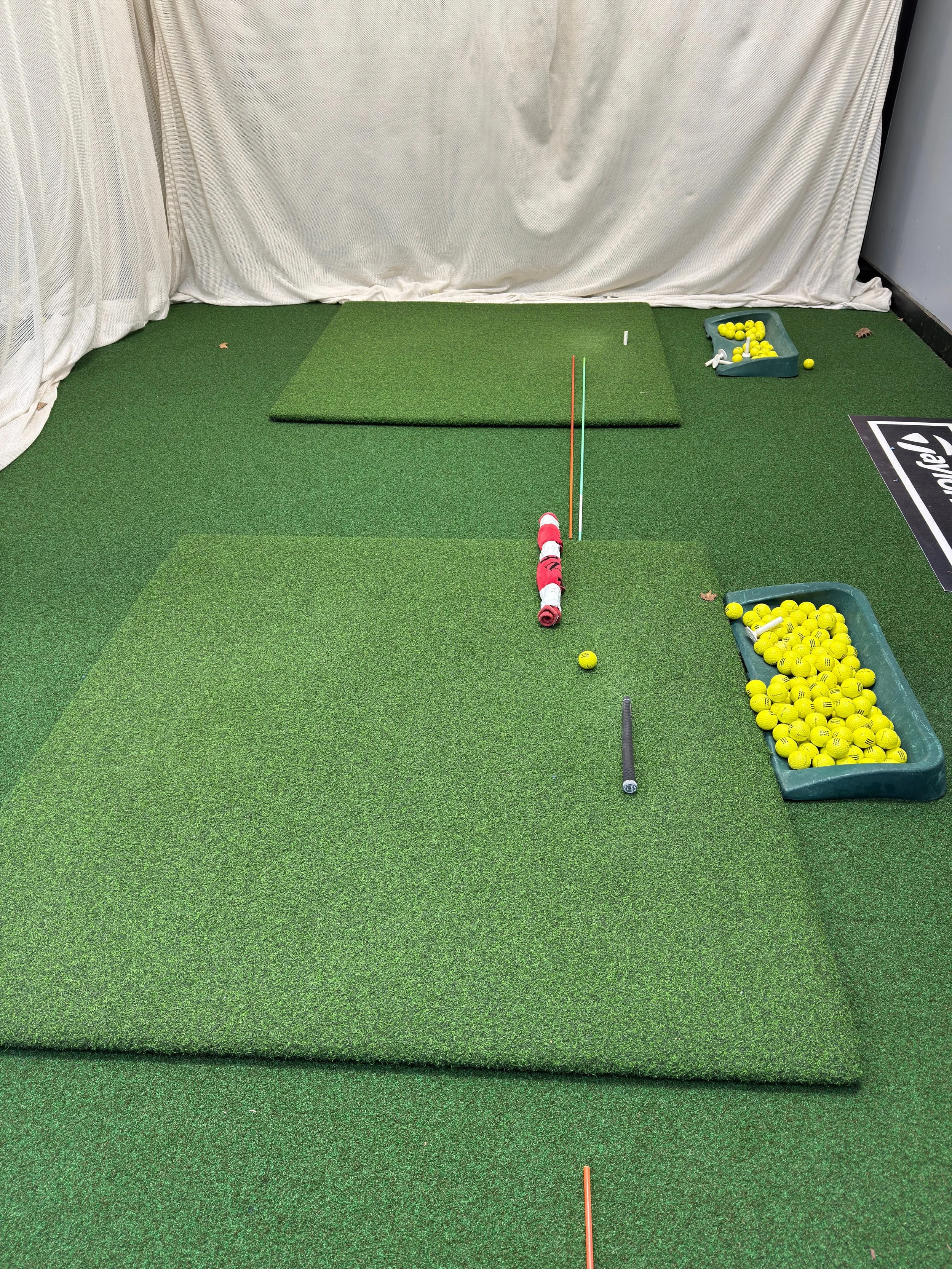
The Low Point is the location relative to the ball where the clubface bottoms out on your swing arc. Trackman measures in inches whether the low point is “B” before the ball or “A” after the ball. You want the low point of your swing to occur in front of the ball. On a well executed iron shot, the clubface hits the ball first, and then the club strikes the ground or mat after the ball on the target side. If your divots start before the ball, your low point was before the strike, and you hit a fat shot. Low point or ground contact is a critical skill for the following reasons. If a significant portion of your swings have a low point in front of the ball, you won’t have a lot of fun playing golf. This is why I rank it the number 1 skill for this post. Not because it’s difficult to master, but it’s a first priority to ensure enjoyment playing golf. Fat shots don’t go very far and they kill confidence. You won’t know how far you hit each club. Also, driving range mats provide help when you hit behind the ball. You can have an OK result hitting the mat before the ball. But actual turf provides no such help. There are many reasons why the low point can be before the ball. Too many for this post. But many drills and devices are available so you can dedicate entire practice sessions to this skill. The classic Divot Board is a great tool that I use during lessons. Other methods include putting a towel, or a couple of tees, a few inches behind the ball. If your low point is before the ball, you will strike the towel or the tees. Another method is to put a tee a couple inches in front of the ball, and concentrate on the low point in front of the ball. When hitting on grass practice tees, you can use powder spray to make a line on the grass perpendicular to the target line, place balls on that line, and hit them. Look to see that your divots start in front of the line.
2) Club Face Control
I ranked low point number 1 because the majority of the world’s golfers are high handicaps who play a few times a year. For this huge mass of golfers eliminating fat shots in favor of ball-first consistency would open up a new world of scoring and fun. But golfers with lower handicaps already have low point licked. Ground contact is an afterthought. For this group, the most important skill is Club Face Control. The metric Club Face is the number of degrees the face of the club is open or closed relative to the target line at impact. If you can square the face at impact consistently, you won’t lose balls, you can count on a shot shape, you will have distance control, and can save you from extreme club paths. Going from a wild club face to a legitimately controlled one can give you the biggest drop in scores you will ever have. Another consideration is, until you control the face, how can you work on skills like club path, aim, speed, trajectory, shot shape, or anything else? One of my favorite practice sessions is to turn on the launch monitor, hit all the clubs in my bag, and for every single swing the only goal is clubface <= 2 degrees. Anything more than 2 degrees open or closed is a fail for that swing. If you don’t have a launch monitor, you can lay down a club or stick in front of the ball down the target line. If you are a righty and the ball flies to the right of the stick, the face was probably open, if it launches to the left of the stick it was closed. An extreme club path can affect this visual somewhat but it works. You can also spend time trying to purposely hit shots with an open, closed, and square face. I have noticed something very encouraging when working on clubface during lessons. Usually, just making someone aware they are consistently opening or closing the face is enough to have them fix it. Pointing out the various causes I see and making those changes helps (obviously), but just letting the player know it’s an issue that needs solving works wonders. No matter what your swing looks like today, you can practice and improve your clubface control.
3) Center Contact
Hitting the ball on the sweet spot of the clubface is an important skill to maximize distance and consistency. It’s true for all clubs but even more important for drivers and fairway metals. If you miss the sweet spot, distance suffers for all clubs. But for drivers and fairway metals, there is something called the Gear Effect that can cause hooks and slices despite what your clubface and club path numbers are for that swing. Because the center of gravity is well behind the club face, the head twists at impact on off-center hits. Long story short, hitting a driver on the toe will produce hook spin, and hitting the heel produces slice spin. When you hit an iron on the toe or the heel you feel each result in your hands. An easy diagnosis. But the driver face is so big and forgiving it can kind of all feel the same. You could be hitting the toe or heel consistently and not realize it. I find it common during lessons that folks line up too close to the ball with a driver, and too far away with irons. Using impact stickers or powder spray verifies this. Adjustments are made, and the next thing you know, iron strikes sound different and are going farther. When necessary adjustments are made with the driver, better center contact results in more distance from the trampoline effect (more ball speed) and the spin rate usually decreases (more carry and more role). It is important to mention that better center contact isn’t just “stand closer or farther” from the ball. The source and cause of off-center hits are many. Spend a practice session working solely on this skill. Understand what your tendencies are for off-center strikes. My tendency for mis-hits is out towards the toe. While practicing center contact remember what all the different strikes feel like in your hands. That way you will know instantly on the course whether the strike was heel, toe, or center. You’ll also know whether the strike was low or high on the face. While the goal is center contact every strike, another outcome is you knowing instantly where the ball stuck the club.
4) Club Path
Club Path is the horizontal direction of the club head at impact relative to the target line. It tells you if the swing was in-to-out or out-to-in. An in-to-out swing approaches the ball from inside the target line then travels outside after impact. With a square clubface, an in-to-out path produces a draw or hook curve to the shot. An out-to-in swing with a square face produces a fade or slice curve to the shot. While most instructors and elite players strive for in-to-out, and I teach true beginners the in-to-out swing, I don’t believe out-to-in swings must be changed. Tiger Woods and Jack Nicklaus hit fades and they were pretty good. Out-to-in swings are steep and over the top and can go way bad a million ways compared to in-to-out. But steep swingers can compress the ball reliably as low point is moved forward so there are fewer issues with fat shots. For golfers who play 10 - 20 rounds a year, which is the majority of golfers worldwide, maintaining an out-to-in path of 0-3 degrees can be the way to go. Players with extreme in-to-out swings have problems too. The shallowing craze has gotten to the point where I’ve had players show up like… dragging the handle sideways through the hitting zone. haha. Getting stuck and handsy or issues coming down behind it. In my experience, a club path consistently higher than 6 degrees in either direction is too high. You’ll have a lot of mishits and severe curve. This is when we will work during lessons to “quiet” the club path as I call it. Meaning the club path should consistently be low numbers 0-4 degrees. Here’s the good news. It’s a relatively easy thing to change with a high success rate. For example, getting players with a 6-10 degree out-to-in swing to a consistent 0-3 degree swing is accomplished with a selection of drills, sticks, and well-placed objects. Players who seek a complete change to a draw swing usually get it done. Club path changes are doable.
5) Speed
Some golfers might read this and say, “how can speed be last?!” To their point, speed and distance are leading indicators of your scoring potential. However, what good is more speed if you are hitting behind the ball, can’t control the clubface, constantly hit the heel or toe, and have an extreme club path? In these scenarios, more speed leads to more severe mishits. The issues are amplified. Instead of hitting your drive into the hazard, it goes over the trees and onto the highway. Others might read this and think, “when it comes to speed you either have it or you don’t.” That is somewhat true, but more speed is attainable for most players through improvements unrelated to swinging harder or hitting the gym bro. Max speed in the golf swing comes from a combination of factors working in unison. Your hip and shoulder turns, depth and length of the backswing, using ground forces, lead hand grip, wrist hinge and release, weight transfer from trail to lead, lead arm throwing or dragging, and being connected. I’ve had success working with players on these individual factors and the result has been increased iron swing speeds by 5-10 mph. More with a driver. We pick the low-hanging fruit after swing analysis and start there. When all that is optimized then you can start a workout program and get wicked huge for more speed kid. Remember, when working on speed you want to increase your cruising speed. Cruising speed means you end up on balance fully able to hold your finish for a couple of seconds. If you can’t, you are out of control. You can also work to have the same swing speed per iron, which leads to legitimate distance control. You can also work on driver ball speed. Getting the face closer to square, with a “quiet” (low degree) in-to-out club path, with a positive angle of attack, while hitting the center, can increase your driver ball speed the same or more than adopting a fitness and mobility program.
Devoting practice time to each of these skills not only increases consistency and lowers scores, it’s a great way to change up your practice sessions and keep things fun!